
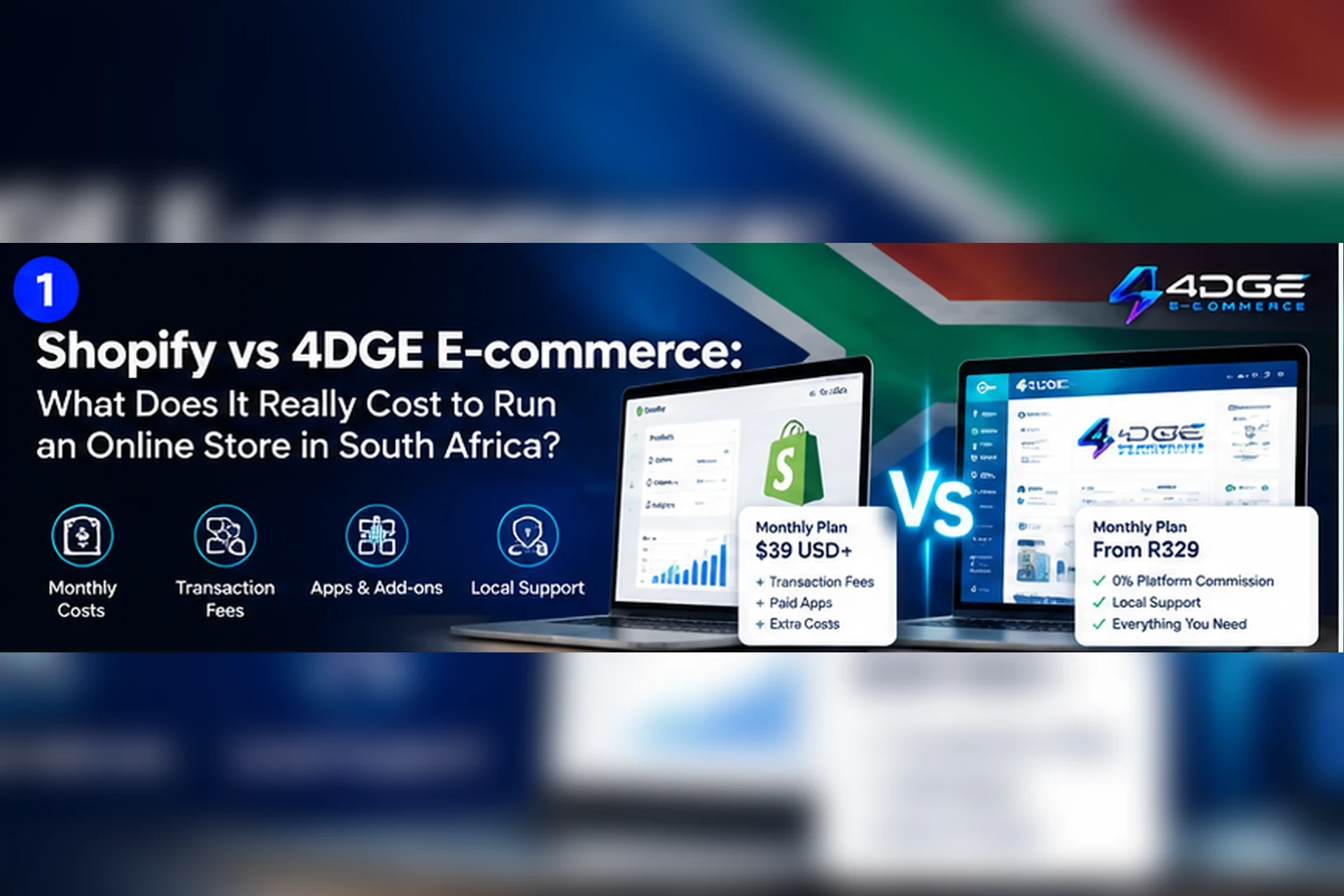
Choosing an online shop platform is a practical decision about how you will list products, take orders, manage the work behind each sale and pay for the tools you use. Shopify and 4DGE E-commerce both help businesses sell online, but they are different offerings with different operating models. The right choice depends on your catalogue, growth plans, preferred level of control and the support you want nearby.
This guide compares the questions a South African business should ask before committing. It is not a claim that one platform is best for every merchant. Platform plans and payment terms change, so check the provider’s current information before making a decision.
What South African businesses should compare
Compare the whole operating picture, rather than a headline subion alone. Look at what is included in the plan, whether extra apps or services are needed, how payments are processed, what control you have over the storefront, and how you will get help when something blocks an order. Also check how the price is billed, what currency applies to your account and whether taxes or provider charges sit outside the advertised subion.
A useful exercise is to write down the tasks your store must handle in its first year: product setup, stock updates, discounts, order fulfilment, payment reconciliation, customer questions and marketing. Then map each task to a native feature, an add-on or a manual process for each platform.
Pricing model
Shopify offers subion plans with different features and billing options. Its plan page lists current plan terms and feature comparisons; pricing and payment terms can vary by market and by billing choice. Review the current Shopify pricing page and its billing overview rather than relying on an old screenshot or a price quoted for another country.
4DGE’s approved public plans are Launch at R149 per month or R1,490 per year, Grow at R249 per month or R2,490 per year, Business at R399 per month or R3,990 per year, and Pro at R499 per month or R4,990 per year. All four include 0% platform commission and custom domain support. The Launch Monthly option has a 14-day free trial: R0 is due today, no payment details are required, and the trial does not automatically convert into a paid plan. Check 4DGE plans for the current inclusion list and terms.
When comparing subions, add the tools you actually need. A plan that appears cheaper at first may require paid extensions, while a higher subion may include capabilities that would otherwise be purchased separately. The reverse can also be true: a broad feature set is not good value if your business will not use it.
Platform commission and payment processing
A platform commission is a fee charged by the commerce platform as a percentage of sales. Payment processing is a separate service charge set by the chosen payment provider for processing a transaction. They should never be combined into one vague “transaction fee” comparison.
4DGE’s public plans have 0% platform commission. That does not remove payment-provider costs: merchants should review the current fees, settlement timing, supported methods and dispute process of the gateway they choose for their own storefront. Shopify’s payment-related charges and available providers depend on market, plan and setup. Read the current Shopify and payment-provider terms for your country before estimating the total cost.
Store setup and everyday product work
For a new merchant, the first test is whether the platform makes a complete store manageable: adding product names, photographs, options, prices and stock; arranging categories; reviewing orders; and keeping customer-facing information accurate. Consider the number of products you expect to launch with and how often the range changes.
Shopify documents an online store, products, inventory and sales channels as part of its commerce offer. The depth of capabilities depends on the current plan and any applications connected to the store. 4DGE provides a hosted store administration experience with product and order management. Check the live plan comparison to confirm the exact limits for your business rather than assuming that an included feature is unlimited.
Before choosing, create a short sample catalogue and walk through the real tasks. Can you create a product with options? Can someone else on your team understand the order workflow? Can you find a specific order quickly? These small checks are more useful than a feature list if they reflect your daily work.
Themes, storefront control and domains
Store design affects trust and conversion, but visual choice alone does not determine whether a platform is suitable. Review mobile presentation, page speed, accessibility, product detail layouts and how easily your team can maintain the design. 4DGE includes theme choices and custom domain support across its approved plans; see available themes and test a theme with your own products and brand assets.
Shopify also provides themes and storefront customisation. Its theme and domain options should be assessed against the kind of design control you need, the technical skills available to your team and any apps or developer work your chosen setup may require. In either platform, check the actual domain connection process, renewal responsibility, SSL coverage and the way you can export or redirect URLs if you later move.
Marketing and automation
Marketing tools can include discount codes, email connections, social selling integrations, analytics and automated messages. “Available” may mean built in, included only on a particular plan, or supplied by a third-party app. For each workflow, record whether it is included, what data it uses, who supports it and whether it adds a recurring charge.
Shopify’s current plans describe features such as sales channels, reports and integrations, with differences between plans and extensions. 4DGE provides a platform with store tools and plan-based features; consult the current public plan list before relying on a specific capability. A clean core setup with only a few well-understood tools is often easier to maintain than a large stack assembled before the business knows what it needs.
Local support and operating context
Support quality matters most when an issue affects a sale or customer. Ask how support is contacted, what hours apply, which matters are handled by the platform versus a payment provider, and what information you should supply when reporting a fault. For an overseas provider, support may still be excellent; the relevant question is whether its channel, hours and product fit your team.
4DGE is a South African e-commerce platform from 4DGE Technology. A locally focused product may suit businesses that value local context and direct support. Shopify serves merchants internationally and has extensive product documentation. Compare the support terms available to your account instead of assuming that location alone determines response quality.
Who Shopify may suit
Shopify may be a strong fit for a business that wants a mature commerce ecosystem, a wide range of integrations, established documentation, multi-channel selling or room to customise through apps and developer resources. Its international reach can be useful for merchants with cross-border ambitions. A business should still model its plan, app and payment costs using its own country and payment setup.
Who 4DGE E-commerce may suit
4DGE may suit a South African business looking for a locally focused hosted platform, a clear ZAR subion menu, included custom domain support and a 0% platform commission model. Launch Monthly offers a 14-day trial with no payment details and no automatic paid conversion. The right test is to confirm that the plan limits, theme, payment gateway choices and workflows fit the store you intend to run.
A simple comparison checklist
- Write a 12-month cost estimate including subion, apps, domain, email, payment processing and professional help.
- Test product setup, stock changes, order handling and refunds with realistic examples.
- Check mobile storefront presentation and the time needed to update content.
- Confirm gateway availability, processing fees and settlement arrangements directly with the provider.
- Read support, renewal, export and cancellation terms before importing a catalogue.
Final comparison
Shopify and 4DGE address overlapping needs, but the better choice depends on which trade-offs matter to your operation. Shopify offers an established international ecosystem; 4DGE offers a locally focused option with clear published ZAR plans and 0% platform commission. Compare total cost, usability, support and the complete customer journey with your own products before choosing.
Ready to compare the local option? Review 4DGE plans, or explore themes and see which setup fits your business.
Compare the work, not only the feature list
Use a small scorecard based on your own priorities. For example, give each platform a rating from one to five for ease of product setup, cost clarity, payment fit, design flexibility, access to help and room to grow. Add one sentence of evidence beside every score, such as “we completed a test order without help” or “this workflow needs a paid app”. A score without a practical reason is only a feeling.
| Question | What to check |
|---|---|
| What is the recurring cost? | Plan, apps, email, domain, and any usage or payment-provider charges. |
| Can the team operate it? | Product edits, order review, refunds, fulfilment and routine content changes. |
| Does it fit South African operations? | Available gateways, settlement, tax handling, support route and currency. |
| Can you change later? | Data export, URL redirects, domain access and migration effort. |
Then compare the same three real scenarios on both systems: a new product with variants, a discounted order and a refund or cancellation. Note where your staff need help, which steps are automated and which information has to be re-entered. This reveals workflow friction that a marketing page cannot show.
Plan for growth without buying everything on day one
It is easy to overestimate what a new store needs. Start with the product range, checkout and fulfilment process you can support today. Add marketing automation or integrations when you can name the business problem they solve and the person who will maintain them. Keep a monthly list of subions and review whether each one is still being used.
Also prepare for a move between providers even if you do not expect one. Keep original product photos, deions, customer consent records and domain access in systems your business controls. Understand each provider’s export options and terms. Moving platforms is not just a data download: redirects, payment setup, staff training and customer communications can all require time.
For a small South African business, the practical winner is the platform that fits your budget and lets your team fulfil orders accurately. Trial both workflows where available, confirm the total cost using current official pages, and decide based on evidence from your own store.


Sign In to Comment
Don't have an account Sign up