
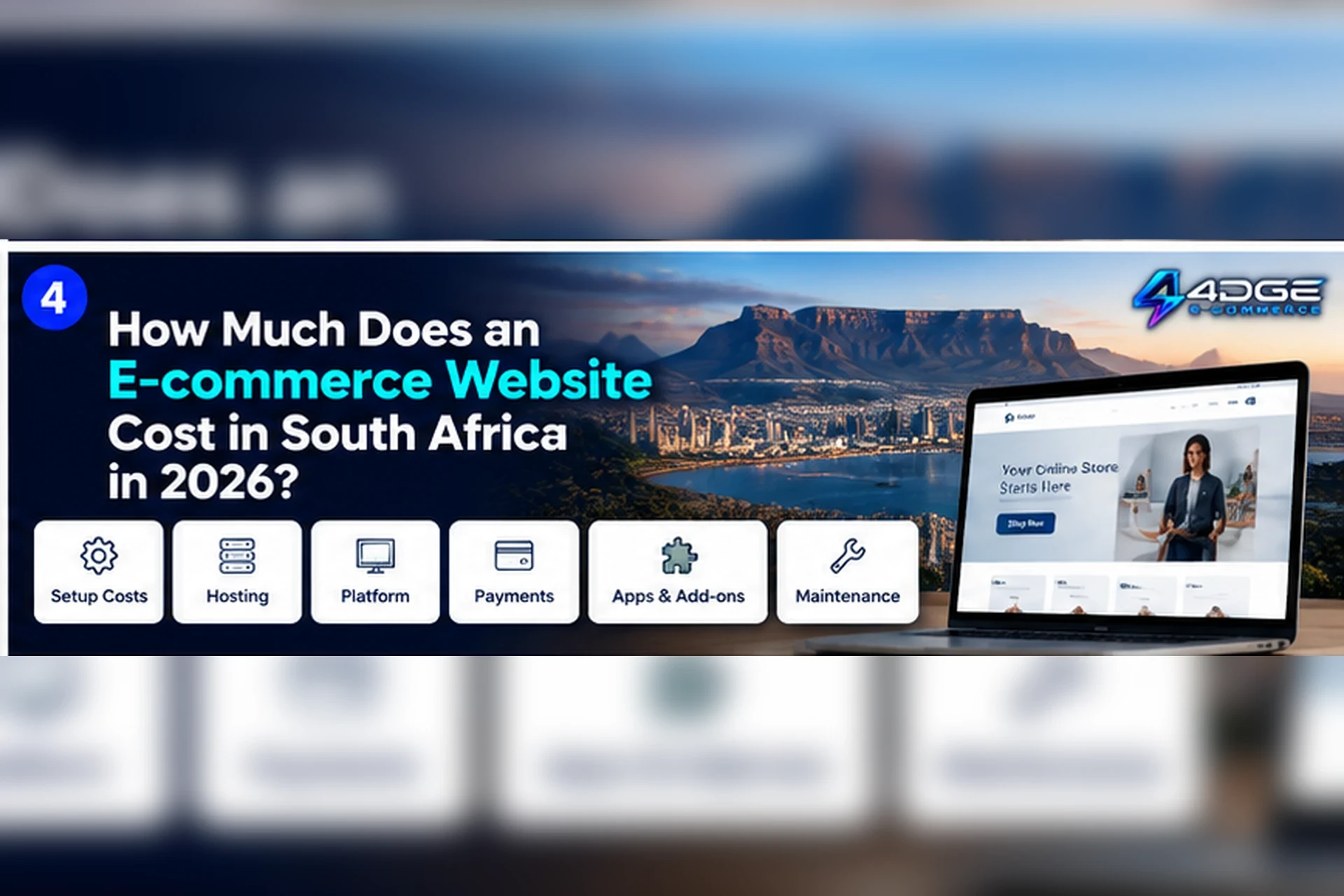
“What does an e-commerce website cost in South Africa?” has no single answer. A shop can be assembled from hosted software, a custom WordPress build or a bespoke application, and each approach puts different work and costs on the owner. The useful question is what the complete store will cost to launch and operate at the level your business needs.
This 2026 guide offers a practical way to build a budget. It avoids claiming that every business pays the same market rate. Prices and provider terms change, so obtain current quotes for your own requirements.
Start with the operating model
Before collecting prices, decide whether you want a hosted SaaS platform, a self-hosted system or a custom build. A hosted service usually bundles some software and infrastructure into a recurring plan. Self-hosting gives the business more control but requires coordination of hosting, updates, security and extensions. A custom build can match a specific process, but the business must budget for design, development, testing and ongoing technical ownership.
Compare the full operating responsibility, not just the first invoice. Ask who updates the software, monitors availability, restores backups, fixes checkout failures and supports the team. A lower subion can still mean more owner time or external work.
Platform subion
A SaaS plan is usually a predictable recurring line item. Check whether the quoted price is monthly or annual, whether tax is included, what limits apply to products or staff, and what features require a higher tier. Confirm renewal timing and the process for changing plans.
4DGE’s approved public prices are Launch at R149/month or R1,490/year, Grow at R249/month or R2,490/year, Business at R399/month or R3,990/year and Pro at R499/month or R4,990/year. All plans include 0% platform commission and custom domain support. Launch Monthly includes a 14-day trial, R0 due today, no payment details required and no automatic paid conversion. Verify current plan terms at 4DGE Pricing.
Domain and DNS
A domain name has a registration period and a renewal price. Check the registrar’s current quote for the exact domain and extension you want, and keep the account under the business’s control. DNS settings connect the name to the website and may also be needed for email verification. Allow time for configuration and confirm ownership before launch.
Include renewal reminders and account recovery in the budget process. A domain is a business asset; losing access can disrupt the shop and email even if the platform itself is working.
Business email
Professional email may be part of a hosting or productivity subion, or a separate service. Decide which addresses are needed, how many people need mailboxes, and whether shared addresses such as support@ should be handled by a mailbox or group. Check storage, security, mobile access, archiving and account recovery. Include domain DNS verification and the time needed to migrate existing mail if applicable.
Theme, design and content
A theme can reduce the time required to build a consistent storefront, but the theme itself is only one part of presentation. Consider configuration, brand assets, product photography, page copy, accessibility, mobile layouts and content entry. Use a design that makes product information and checkout clear, not merely one that looks polished in a demo.
Some businesses can configure a theme internally; others hire a designer or developer. Get a defined scope, ask whether revisions are included and make sure the business retains access to the resulting files, images and accounts. Product photography and copy may need to be refreshed as the catalogue changes.
Product setup and catalogue quality
Uploading products takes time. Prepare accurate names, deions, SKUs, options, prices, stock levels, shipping weights, tax details and images. If there are many products or variants, estimate the data-cleaning and import work separately from the platform subion. Check the mobile product page and order confirmation using a representative item before loading the whole catalogue.
Good product information also reduces questions and avoidable returns. Budget for review of spelling, image rights, measurements, care instructions and stock rules. Keep a source spreadsheet or inventory system current so the store does not become a second, conflicting record.
Payment processing
Payment providers may charge transaction, settlement, refund, chargeback or other fees under their own terms. These charges are separate from a website plan. Compare the methods customers use, merchant eligibility, settlement timing, refund workflow and support. Use the provider’s current fee schedule for your business type and transaction mix.
Do not treat a platform’s commission policy as a substitute for payment pricing. 4DGE charges 0% platform commission on all approved plans, while the merchant’s payment provider may still charge its own processing fees. PayFast is the provider for 4DGE SaaS plan payments; that does not mean every merchant storefront is limited to PayFast.
Marketing and customer acquisition
A website does not automatically bring visitors. Marketing spending may include search optimisation, paid advertising, email tools, social content, product sampling or photography. Some work can be handled in-house; paid campaigns need a clear budget and a way to evaluate results.
Start with the customer and the channel they already use. Set a small, measurable campaign goal, such as visits to a product collection or email sign-ups, and check what happened before scaling the spend. Do not assume that a particular sales result follows from a set advertising budget.
Integrations and add-ons
Businesses sometimes need accounting, inventory, delivery, customer support, analytics or marketing integrations. Check whether the service is included, requires a licence, charges by usage or needs a developer to connect it. An integration also creates an ongoing dependency: someone must monitor failed syncs and keep permissions current.
List the business task first, then choose the smallest set of tools that solves it. Avoid buying several subions before confirming that the core workflow works. Document the owner of each integration, renewal date and support contact.
Maintenance and support
Every store needs an owner for routine tasks: checking orders, updating products, reviewing returns, keeping delivery rules current and responding to customer questions. Depending on the operating model, there may also be hosting renewals, security updates, backups, compatibility checks or developer support. Include staff time alongside cash expenses.
Make sure critical flows are tested after major changes. A backup plan should explain what is saved, how it is restored and who can access it. A support plan should say where to report an incident and when a response is expected; do not assume every vendor offers the same level of help.
Custom development
Custom features can be worth building when they solve a clear, recurring business need. They also create responsibilities for specification, design, implementation, testing, security review and future maintenance. Before approving a build, ask for a written scope, acceptance criteria, delivery milestones, handover documentation and clarity about ownership of code and accounts.
Separate launch costs from ongoing support. If the business depends on a custom integration, consider what happens when an API changes or the original developer is unavailable. An off-the-shelf process may be less tailored but simpler to operate.
Three budget examples without invented market prices
These are planning scenarios, not market quotes. Replace every variable with a current written price from the provider you choose.
- Lean launch: one SaaS plan or an existing self-hosted setup, a domain renewal if needed, a free or included theme, owner-written copy, a small catalogue and a payment provider. Record staff time for product setup and customer service.
- Supported launch: a SaaS plan, domain and email, paid design or content help, assisted product entry, and a selected set of integrations. Include the recurring charges and any renewal dates for each service.
- Custom operation: a tailored build or substantial development, specialist testing, integrations and an agreed maintenance arrangement. Ask for an implementation quote and a separate annual support estimate; do not treat the initial build as the entire cost.
For each scenario, make a month-one cash column and a recurring monthly or annual column. Identify one-off work, recurring licences, usage-based fees and unknowns separately. This makes the budget useful without pretending that a generic figure applies to all South African businesses.
A simple worksheet
| Cost area | Questions to answer | Timing |
|---|---|---|
| Platform | Plan, limits, renewal and included support | Monthly or annual |
| Domain and email | Registration, renewal, mailboxes and DNS | Annual or monthly |
| Design and content | Theme, images, copy and setup scope | One-off plus refreshes |
| Payments | Provider fees, settlement and refund terms | Per transaction or service period |
| Tools | Integrations, licences and usage limits | Recurring or usage-based |
| Operations | Staff time, support, backups and maintenance | Ongoing |
| Marketing | Channel, spend cap and measurement | Campaign or recurring |
Conclusion
The cost of an e-commerce website depends on the service model, catalogue, payment needs, design ambitions and level of support. A useful estimate separates software, domain, email, setup, processing, integrations, marketing and ongoing work. Collect current quotes and compare the obligations that come with each choice.
For a locally priced hosted option, review 4DGE’s plans and compare them with the complete costs of the alternatives you are considering. Start with the business workflow and budget rather than a headline price alone.
Review the budget as the shop grows
Costs often change when a business adds products, staff, markets or integrations. Set a quarterly review to check actual invoices against the budget, remove tools that are no longer used and update renewal dates. Compare the new workload with plan limits before a busy season. This simple review helps the owner see whether the store model remains suitable and what investment is genuinely needed next.


Sign In to Comment
Don't have an account Sign up