
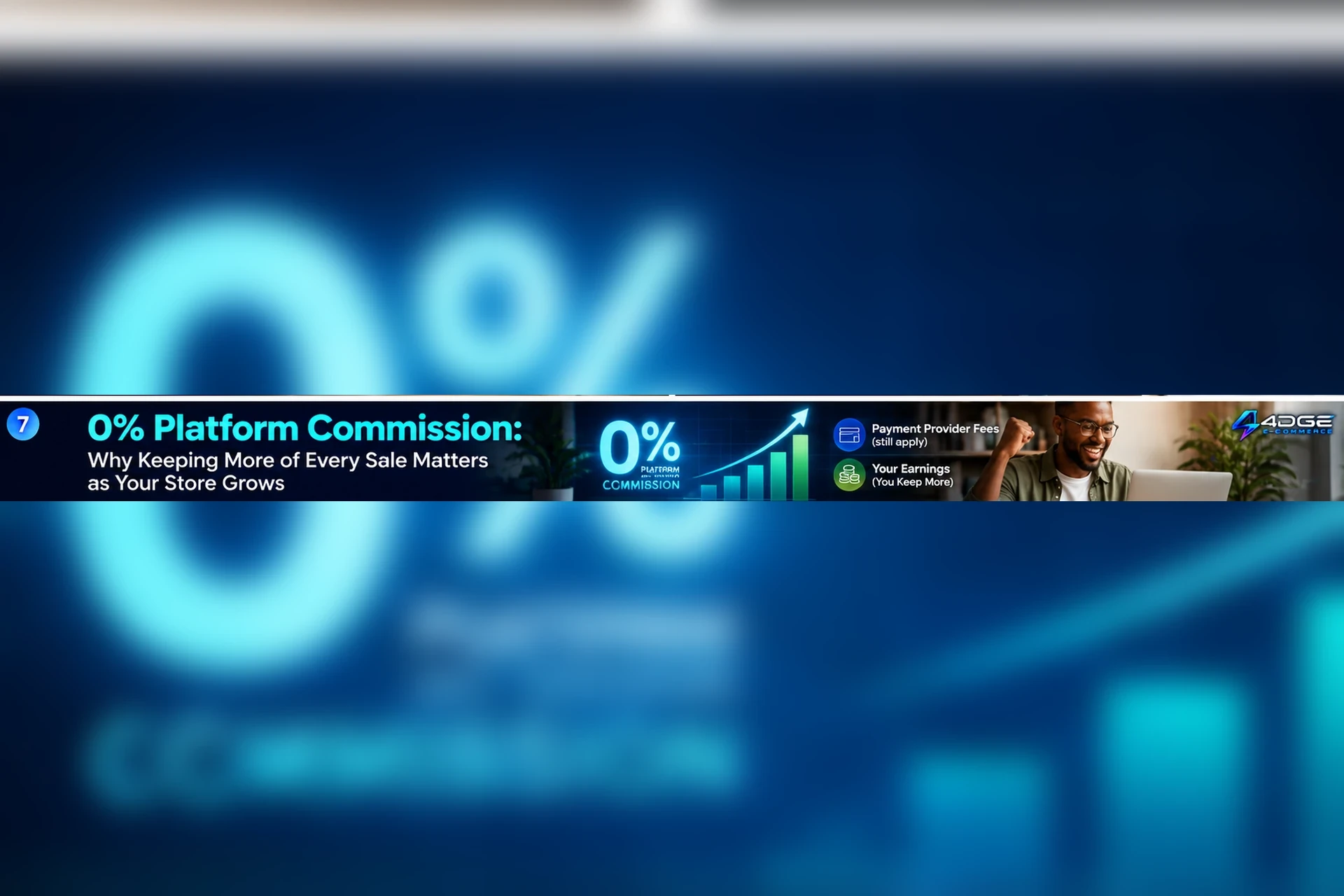
Many online platforms charge a recurring plan fee, a percentage of sales, or a combination of both. A percentage charge can look small on an early order, yet its effect changes as sales volume grows. Understanding the difference between platform commission and payment processing helps an owner compare offers on the full cost rather than a headline figure.
This guide explains how a platform commission works, why it can scale with revenue, and how a 0% platform commission model fits into a broader budget. The examples below are hypothetical illustrations only. They are not forecasts or a promise of savings.
What platform commission means
Platform commission is a charge imposed by the commerce platform on sales processed through its service. The rate, calculation basis and covered transactions depend on the provider’s terms. Some offers may distinguish between plan levels, payment methods, order types or other conditions. Read the current agreement to understand whether the fee applies to gross sales, net sales, refunds, taxes, shipping or discounts.
Do not assume that two providers use the word “commission” in the same way. Ask for a written explanation and calculate it using the transactions that matter to your business. A low rate can still be material at scale, while a higher fixed plan may or may not be better depending on the tools and support included.
Platform fees and payment processing are different
A platform subion pays for access to software and its included capabilities. A platform commission, when charged, is a separate charge based on sales under the platform’s terms. Payment processing is charged by the payment provider for handling a transaction and may include fees or rules for settlements, refunds and disputes.
These are different services and should appear as separate lines in a comparison. A platform advertising 0% commission does not mean that customers can pay without transaction processing costs. Check the payment provider’s current pricing, supported methods, onboarding requirements and settlement arrangements independently.
Why percentage fees change as sales grow
A percentage is applied to a larger base as revenue increases. If the rate remains constant, the amount paid in commission rises in proportion to the sales covered by the fee. That can make a variable charge more noticeable during a successful promotion or a busy season, even if the business has not changed its platform.
Growth can also make predictability more valuable. Owners may prefer to know their recurring software cost while modelling other variable expenses separately. That does not make every percentage-based service unsuitable; it means the calculation belongs in the plan comparison and cash-flow forecast.
Hypothetical examples
The following examples demonstrate arithmetic, not any provider’s actual price or a forecast of business results. Assume only for illustration that a platform commission were 1% of the sales amount described. Exclude taxes, refunds, payment processing and all other charges so the effect of that one hypothetical rate is easy to see.
| Hypothetical monthly sales | Illustrative 1% platform commission |
|---|---|
| R20,000 | R200 |
| R100,000 | R1,000 |
| R500,000 | R5,000 |
The table does not say that a particular platform charges 1%, nor that these sales levels are typical. It simply shows how a percentage calculation scales with its base. For a real decision, substitute the actual rate and rules in the written provider terms, then include payment-provider fees, the platform plan and any relevant tax or refund treatment.
Predictable software costs can help planning
A fixed subion can make one part of a monthly budget easier to forecast. The amount is generally defined by the selected plan, although its price and terms can change according to the provider’s agreement. A fixed plan does not remove variable costs such as payment processing, delivery, advertising, returns, inventory or staff time.
Look at what is included in the plan and whether it fits your workflow. Product limits, user access, storage, integrations, support and the ability to export information may matter as much as the price. A plan that is inexpensive but lacks a necessary capability could require extra tools; a more expensive option may be worthwhile if it replaces work or services you already pay for.
How 4DGE’s 0% platform commission fits
4DGE’s approved public plans have 0% platform commission and custom domain support. The current approved monthly prices are Launch R149, Grow R249, Business R399 and Pro R499. The approved annual prices are R1,490, R2,490, R3,990 and R4,990 respectively. Confirm current plan details on the 4DGE pricing page.
Launch Monthly includes a 14-day free trial, R0 due today, no payment details required and no automatic paid conversion. These facts describe the 4DGE SaaS subion. Payment-provider fees for transactions on a merchant’s own storefront remain separate and depend on the provider the merchant configures. Do not treat 0% platform commission as 0% total cost of selling.
Compare total value, not one headline
Build a like-for-like comparison with the platform subion, any platform commission, payment processing, add-ons and the internal work required to operate the store. Check plan limits and contract terms, then model at least one current sales month and a realistic higher-volume scenario. Include refunds and seasonal changes if they are relevant to your business.
Also consider reliability, support, storefront flexibility, data access, integrations and how easily staff can complete routine tasks. The cheapest headline price may not produce the lowest total cost or the best fit. Likewise, a 0% commission claim should be checked alongside the complete service and payment model.
A simple comparison checklist
- What recurring plan fee applies, and what does it include?
- Is there a platform commission, and precisely how is it calculated?
- Which payment provider fees apply to your chosen methods?
- How are refunds, disputes, taxes, shipping and discounts treated?
- Are paid extensions or integrations needed for your workflow?
- Can you export your products, orders and relevant customer records?
- What support is available, and under what terms?
- What would the total look like at current and hypothetical higher sales?
Record answers with their source and date. Pricing and terms can change, so verify them with the provider before making a commitment. If you need a feature that is not included, request a full quote rather than assuming it is free.
Conclusion
Platform commission is a percentage-based platform charge, while payment processing is a separate service cost. Because a percentage scales with the sales base, it is useful to model the amount at more than one revenue level. A 0% commission plan can improve predictability for that platform charge, but the owner should still compare subion price, payment fees, tools and operating effort.
4DGE’s approved plans have 0% platform commission. Review the current features and prices on View 4DGE Plans, and compare the complete cost against the way your business sells.
Model more than one business scenario
For a useful comparison, use your own sales mix rather than a single month that may be unusually quiet or busy. Estimate how many orders are likely to be refunded, whether promotions change the average basket, and which sales are actually covered by a provider’s commission. If a supplier’s formula is unclear, ask before relying on it in a forecast.
Then compare the result with the plan fee and other costs. A hypothetical percentage calculation is only one input: the included features, customer experience, support and time saved by a workflow also have value. Keep the assumptions beside your figures so a future review can update the result without treating an illustration as a guaranteed saving.


Sign In to Comment
Don't have an account Sign up